
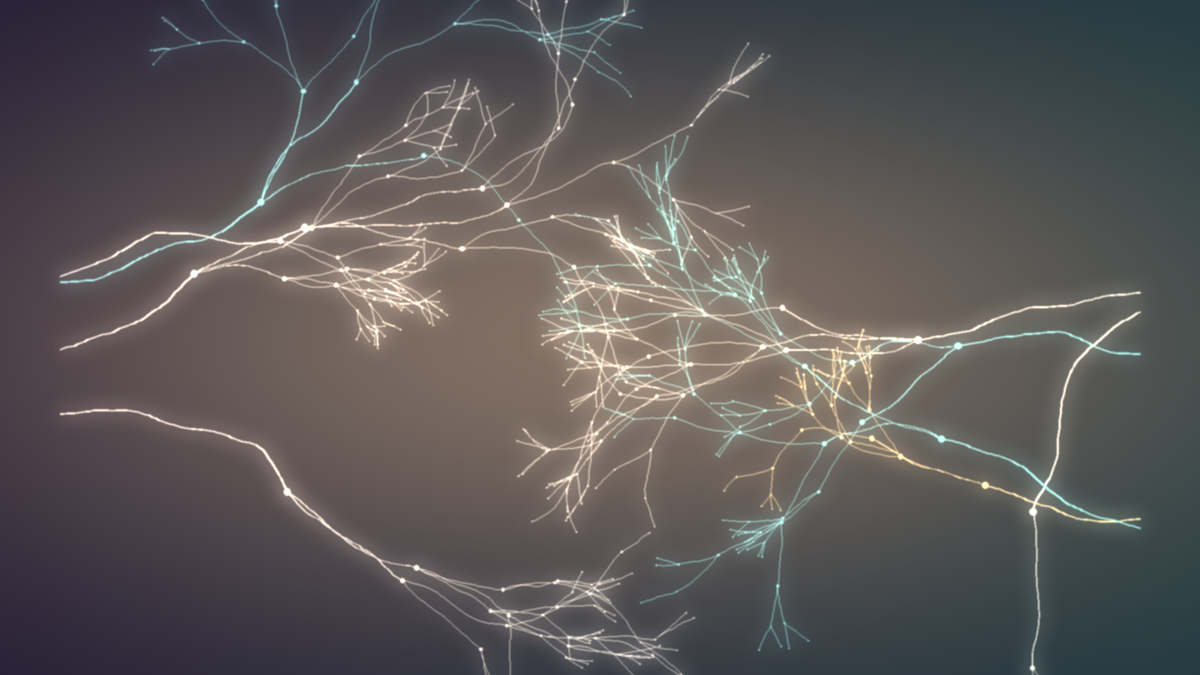
Neuroplasticity, Gently Explained: Your Brain Is Always Listening
Author: Cameron Porter
Every thought leaves a footprint. Every habit carves a path. And every path can change.
I get asked a lot about what happens "inside" when we sit with a practice day after day. So today I want to share something I find quietly beautiful: neuroplasticity, explained simply, from one curious person to another.
No lab coat needed. Just a cup of something warm.
What Is Neuroplasticity?
Neuroplasticity is the brain's ability to change its connections over time, based on what we do, think about and pay attention to.
For a long time, many people believed the adult brain was mostly "set." Scientists now know it keeps adapting throughout life. Not overnight. Not by magic. Little by little, through use.
I like to picture a meadow.
The first time you walk across it, there's no path. The grass springs right back. Walk the same way again tomorrow, and the next day, and the day after that, and a trail begins to appear. Soon your feet find it without thinking.
Your brain works a little like that meadow. The routes you travel most become the easiest to travel again.
So here's my question for you: which paths have you been walking without noticing?
Neurons That Fire Together
Back in 1949, a psychologist named Donald Hebb proposed an idea that's often summed up in one catchy line: "neurons that fire together, wire together."
In plain words, when brain cells are active at the same time again and again, the connections between them tend to strengthen. That's one of the ways learning happens. It's why the first time you drive a car feels like juggling, and the hundredth time feels like breathing.
It's also why a song can take you straight back to a summer you'd forgotten. Things that happened together got linked together.
I find that both humbling and hopeful. Humbling, because so much of what I do runs on old wiring I never consciously chose. Hopeful, because wiring that was learned can keep learning.
The London Taxi Drivers
One of my favorite studies is about taxi drivers. (Stay with me, this one's fun.)
To earn a license in London, drivers spend years memorizing a maze of thousands of streets, a test famously called "The Knowledge." In 2000, researcher Eleanor Maguire and her colleagues scanned the brains of experienced London taxi drivers and compared them with people who didn't drive taxis.
They found that a back part of the hippocampus, an area involved in navigation and memory, was larger in the taxi drivers. And the longer someone had been driving a taxi, the larger that area tended to be. (A front part of the hippocampus was a bit smaller, a reminder that the brain is always balancing.)
Now, I want to be honest about what this does and doesn't show. It was a small study of one specific skill. It doesn't mean any practice will reshape your brain in a particular way. What it does offer is a lovely real-world glimpse of the bigger idea: what we repeatedly use, the brain tends to make room for.
So How Long Does a New Habit Take?
You may have heard that a new habit takes 21 days. I used to believe that too.
In 2009, Phillippa Lally and her team at University College London followed 96 people as they tried to build a new daily habit, like drinking water with lunch or going for a walk. On average, it took about 66 days for the new behavior to feel automatic. And the range was wide, from 18 days to 254 days, depending on the person and the habit.
Here's the part I love most. Missing a single day didn't meaningfully derail people. Consistency over time mattered more than perfection.
So if you've ever felt like you "failed" a new practice because you skipped a Tuesday, please hear this: you didn't. The meadow remembers your footsteps.
Your Brain Is Always Listening
Here's where science and spirit hold hands for me.
If repetition and attention help shape which paths get stronger, then the words we say to ourselves, the moments we pause for, and the intentions we return to all matter. Not in a pressured way. In a gentle, "what am I practicing today?" way.
I wrote about this in Words Are Alchemists. Words aren't just descriptions. They're also rehearsals.
This is also how I think about Binary Light Codes. I want to be clear here: the codes are a spiritual practice, not a scientific treatment, and I'm not claiming they change the brain. What I can tell you is how I use them. A code gives me something to return to. A focal point. A ritual that pairs an intention with repetition, day after day, so my attention keeps finding its way back to what I want to grow.
Think of it like a lantern on the trail. The walking is still yours.
If you'd like a fuller picture of how the different keys and codes fit together, my guide Innerstanding the Binary Light Codes System is a lovely place to wander next.
A Simple Practice: Walk the New Path
This takes about three minutes. Try it once a day for a week, and notice what you notice.
- Choose one sentence. Pick a simple, kind statement you'd like to practice, written in the present tense. For example: "I meet this day with curiosity." Keep it short enough to remember.
- Pause and breathe. Sit comfortably. Take three slow breaths, letting each exhale be a little longer than the inhale.
- Say it, then sense it. Speak or write your sentence. Then ask yourself, "What would this feel like, right now, even a little?" Let yourself imagine it for a few breaths. If you work with a Binary Light Code, this is a lovely moment to hold it in view or speak it aloud.
- Catch the old path kindly. During the day, if you notice an old thought pattern, there's no need to scold it. Simply say "Oh, there you are," and gently return to your sentence.
- Make one note. Before bed, jot down one moment you remembered your sentence. Just one.
That's it. No perfection required. Remember the 66 days, and remember the missed Tuesdays. Every return counts as a footstep.
What sentence would you choose? I'd truly love to know.
A Gentle Note
This post is for curiosity and reflection. It isn't medical or mental health advice, and a spiritual practice is meant to complement (not replace) appropriate care from a qualified professional. Individual experiences vary.
Where to Go From Here
If this stirred something in you, there are two gentle places to begin.
Begin with three: The Binary Light Codes Starter Bundle ($30). It's where I recommend most people start, a simple set of codes to build a daily rhythm around.
Or walk the path with others: the Binary Light Codes All-Access Membership ($10/month or $100/year). It's a home for ongoing practice, live member calls and a growing community of fellow travelers.
Whichever you choose, or if you simply take the three-minute practice with you today, thank you for walking this meadow with me.
Your brain is always listening. What will you tell it today?
As Love- Cameron Porter
Sources
- Hebb, D. O. (1949). The Organization of Behavior: A Neuropsychological Theory. Wiley. https://doi.org/10.4324/9781410612403
- Maguire, E. A., Gadian, D. G., Johnsrude, I. S., et al. (2000). Navigation-related structural change in the hippocampi of taxi drivers. Proceedings of the National Academy of Sciences, 97(8), 4398 to 4403. https://doi.org/10.1073/pnas.070039597
- Lally, P., van Jaarsveld, C. H. M., Potts, H. W. W., and Wardle, J. (2009). How are habits formed: Modelling habit formation in the real world. European Journal of Social Psychology, 40(6), 998 to 1009. https://doi.org/10.1002/ejsp.674
Read more

Binary Light Codes Testimonials: How Our Community Receives the Codes
Individual experiences vary. Spoken aloud. Woven into daily ritual. Felt in a quiet room. One of my favorite things about this work is that no two ...
Binary Amplifiers & Their Effects
The amplifiers (like 111, 000, 11, 1010) are like power-ups in a video game—they boost, intensify, or modify the effect of a binary code. Let’s bre...